

I’ve got to say, it was a pleasure dedicating an entire article to your questions. I think these interactions are pretty awesome, enough to encourage them to keep happening. 🙂 Also, have you noticed the new design? I suppose it was long overdue, huh? Feel free to be at home 🙂
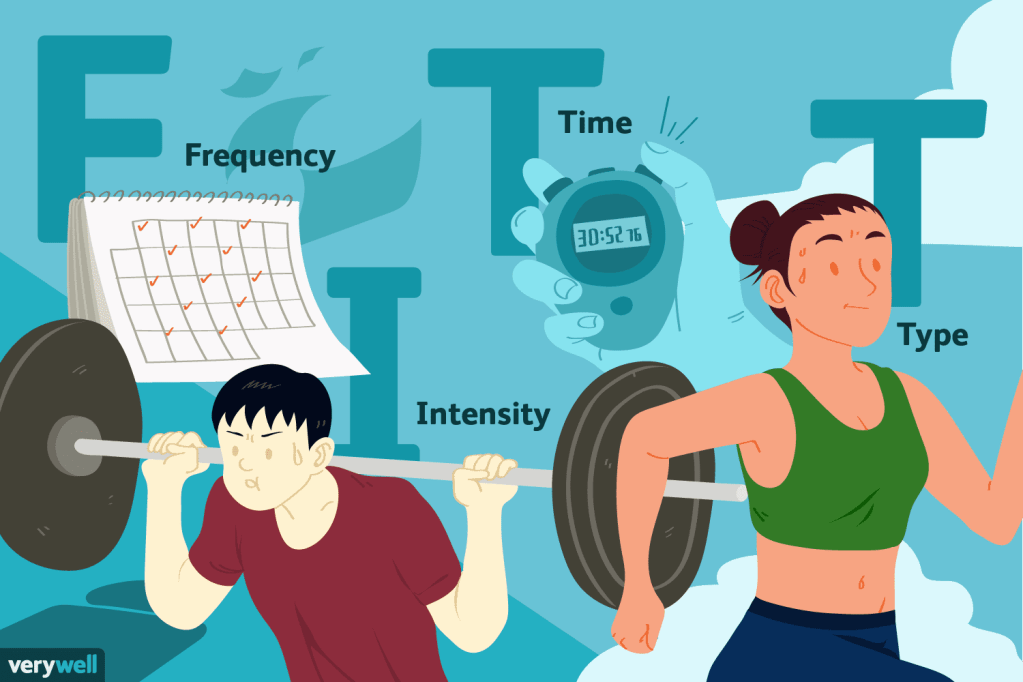
As promised, this article will concentrate on the FITT Principle. Now, as much as we are not talking about a shoe or glass slipper (if you know you know), you may find that this concept may not be too far removed from the fairytale. I mean, the idea was for the Prince to find his elusive Princess, right? Well, here, the idea is to find your perfect fit (no pun intended) to your workout plan 🙂
Let’s dig in
F for Frequency
Wait, wasn’t it ‘f’ for fish? I digress.
Frequency, simply put, is the number of times you do something. In this case, it is the number of times in a week that you exercise; or, in another way, the number of training sessions you have over a specified period of time. For example, training thrice a week, or twice a day (morning and evening).
Most times, especially after either New-Year Resolutions or watching a motivational video, one tends to jump into a daily exercising routine that – many times – they cannot sustain over an extended period of time. Ever been (or heard of) that individual who shows up at a gym for a month then suddenly disappears without a trace?
I for intensity
Intensity, really, is how hard or easy your training session is. For example, when running the 5k, you could either run or jog it – difference is the speed and effort exerted; when going to the shop, you could either walk, jog, run, or sprint it. In fact, this last progression would be the best illustration of how intensity progresses.
The difficulty level depends on the fitness level of the individual, which is why while some may be able to run the 5k, some of us can at best jog it and finish hours later. Similarly, while some may be able to complete 20 burpees in a minute, you may only be able to complete 2 – but hey, that’s a start 🙂
There are some ways you can measure intensity. If you do not have a heart monitor or a power device (like Garmin), your ability to hold a conversation can be used to determine your effort: if you can comfortably talk with someone during an effort, then you are at an easy/low intensity; if you can still talk to someone but have to take pauses here and there to catch your breath, then the activity is moderate to vigorous; and if you can barely speak (if at all), you are at a high intensity.
In case you own a smart watch with a heart monitor, you can measure your effort as a percentage of your maximum heart rate. To calculate your maximum heart rate, subtract your current age from 220 (ie, 220 – current age); and to identify your training zones, simply calculate the relevant percentage of your maximum heart rate.
Just so you are aware, training below 60% of your maximum heart rate is undertraining. Yes, that is a thing.
T for type of exercise
Do you recall back in your schooling years when your PE teacher would begin the lesson by asking you to complete a lap or two, then stretch, and (if it was a lesson they weren’t teaching a new skill) let you play football or hockey until time was up? Haha, I’m pretty sure most of you even remember being asked to find ‘free space’ by swinging your arms around you.
By running those laps, the activity targeted your heart making it pump blood to the working muscles; the stretches targeted your muscles that had been running and that would be used for the duration of the lesson; and the main sport/activity of the lesson targeted very specific body parts and muscles. If, as part of the warm-up you also did push ups, those exercises targeted your muscular strength.
This goes to demonstrate that your exercise choices target different aspects of your body. For example, lifting weights in the gym or even doing strengthening exercises like push-ups and pull-ups and squats work on your muscular strength; running on the treadmill or on the road mainly works on your heart (cardio); working out on the rowing machine targets your muscular endurance (duration your muscles can sustain that activity before getting tired); cycling 100km targets your endurance (duration you can sustain that activity before getting tired)…it’s a whole lot.
Do you now see the importance of being aware of your intended goals before jumping into a workout program?
T for time taken
Simply put, it’s the time taken to complete a workout session or an exercise bout. For example, aerobics for an hour; or swimming for 30 minutes, cycling for 20 minutes and running for 15 minutes (total: 65 minutes) – triathletes, how are you? 🙂
DISCUSSION
Working out, exercising and living actively are all part of a healthy lifestyle. Let me repeat the word: lifestyle. It therefore makes sense that one is encouraged to begin with baby steps. It is unfortunate, in my opinion, that we spend years in school learning about lots of things about the world while majorly neglecting education on how to deal with ourselves, especially when it comes to being patient with ourselves.
It’s not about your training buddy in the gym who can complete 20 burpees in a minute, or your coach who can swim 400m Individual Medley without breaking a sweat – and yes, swimmers do sweat which is why they must stay hydrated even in the water! – or your neighbour who can run the 5k in 15 minutes; rather, it is about YOU. It’s about you developing the ability to accomplish all those things while making it look effortless. That is the goal.
But,
You have got to start somewhere. And that somewhere is not killing yourself everyday trying to already be there. Start small.
Take a look at this table
| FREQUENCY/wk | INTENSITY | TYPE OF EXERCISE | TIME TAKEN |
| 3 | 60% | Jogging | 30 minutes |
This is a simple presentation of a jogger’s exercise routine in a week. To progress, all they have to do is change JUST ONE item in the FITT table.
Some time ago, the body was introduced to this schedule and it nearly shut down on you, right? But as you got consistent, it had no option but to adapt to the stress to the point where this has become a little too easy – you almost barely break a sweat.
| FREQUENCY/wk | INTENSITY | TYPE OF EXERCISE | TIME TAKEN |
| 3 | 60% | Jogging | 45 minutes |
Can you identify what has changed?
By tweaking the time taken column, the exercise has become that much harder hence placing more stress on the body – oops, systems are about to go on maandamano, hehe – and you will feel it. With time (3 – 4 weeks), however, your body will adapt and become that much fitter (yaaaaay!).
| FREQUENCY/wk | INTENSITY | TYPE OF EXERCISE | TIME TAKEN |
| 4 | 60% | Jogging | 45 minutes |
“Aaaargh, one more day!” Your body will complain, but hey, it will get used to it and adapt accordingly. And really, that is one of the most fantastic things about the human body: it’s adaptability to exercise.
Again, as a by the way, failing to ‘progress’ your training leads to a stagnated fitness growth. That is, if you train at the same level for a year, you will remain as fit as when you started, with zero improvement. Changing any one aspect in the FITT table sets you up for improved fitness. 🙂
At this point, I feel like the article has become a little too long, so lemme get into the conclusion. The take-away is: train smart. The athletes you admire didn’t just suddenly become good; they worked through their developmental stages to be overnight successes. Your neighbour didn’t just start running the 5k in 15 minutes; they worked smart (and systematically) to get there.
The main idea is to make your training look as easy as possible to help you keep its doability – is that a word? – over time. All the best!
Cheers!
 WHO'S WORLD OF FANTASY WILL YOU DIVE INTO NEXT?
Leave a comment