A first time on a bicycle can either be a really traumatic or thrilling experience depending on who is coaching you.
As a child, one still hasn’t developed the faculty of overthinking, which makes it relatively easier for them to learn how to ride a bicycle compared to adults.
The latter will look at a bike and ask how it will balance with only two wheels, and whether or not they are capable of riding. The fear of falling is also dominant in their thoughts, and that is understandable given how much easier it is for an adult to get injured compared to a child. A fall that would take a child, say, three days to heal might take two weeks for an adult to recover.
That said, riding a bike is among one of the friendliest physical activities for all ages, and can be practised for much longer than jogging, for instance. The impact you make with the ground each time you strike the ground while running is absent when you cycle, meaning that your knees could last for much longer, leading to an extended period of exercising! Great, huh?
Oh, and before you get comfortable, did you know that once you learn how to ride you will never (ever) forget? Riding is all about getting that sense of balance, and once you acquire it, it’s like learning a second way of being! Haha, now you can get comfy.
Over the years, the most prevalent instructing method has always been the use of stabilisers. However, I’m writing today to assure you that you can learn without them! In fact, unless it is a child of 2 to 3 and a half years, I would advise against the use of the trainer wheels.
Why? Well, because it slows down the learning process; cultivates a false sense of balance; and frankly, is rather embarrassing to be seen as an adult using these support structures.
In my experience, I have found it efficient to hand someone a relatively proper-fitting bike, where when sitted on the saddle can reach the ground with the balls of their feet. Then the fun begins.
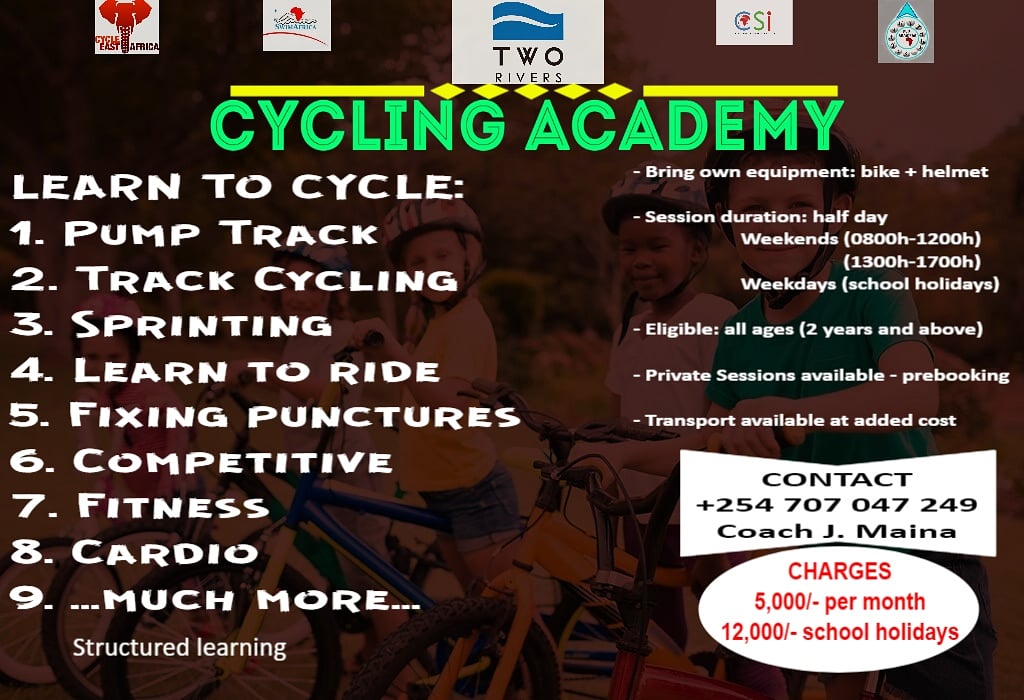
Allow me to use the Two Rivers Sports District, where we have our cycling academy, to create a vivid picture:
From where one hires a bicycle, there is a gradual climb that extends for about 100m before one gets to the cycling track. Here, the learner is encouraged to push their bike up the hill in order to get that warm up in, get the heart pumping and have a feel of how the bike moves (or should move)… The added weight of the bike also makes them accustomed to pushing the extra weight, ie, apart from their body weight.
Once on the field, they mount the bicycle with their feet on the ground while sitted on the saddle. This helps them learn to use their legs for support when the bike is stationary.
Next, they mimick walking while in the previous position so that they have a feel of how the bike moves while under them… It also helps them learn how to use the handlebars for balance.
Next, they increase the pace of walking to a jog, such that the bike gets that momentum necessary to move to the next stage, which is where one is introduced to the idea of balancing on a moving bike.
Remember the question where one asked how it is possible to balance on a two-wheeled bike? Well, here’s the answer: once the bike starts moving, it develops its own sense of balance, which is demonstrated when the learner jogs while on the bike then, on command, lifts both legs and lets the bike cover the distance before putting the feet down again.
Now, we are almost at that stage where you can ride a bike on your own! Amazing, right?😃
Here’s where I now leave you with a question, whose answers I expect in the comments below:
Any idea what the next two steps are?
(DISCLAIMER: this is a fully opined article, so feel free to agree or disagree in the comments below.)
You can reach me at +254707047249, or email us at duobearingsafrica@gmail.com


 WHO'S WORLD OF FANTASY WILL YOU DIVE INTO NEXT?
Leave a reply to Kennedy Cancel reply