OKAY, I ADMIT THAT I thought the cold would be a thing of the past…but there’s a way these short rains have created a conducive environment for it to thrive. Hopefully you didn’t toss out your blankets too soon!
It’s great to have you back. Remember you can always reach out to me via email josemariambui@gmail.com or in the comments below. Also, if you would still like to participate in the running individual time trial race, registration is still ongoing here.
Brilliant! Let’s now delve into the top 3 questions from 2 weeks past. 🙂
Dear Coach, this is a follow-up question to what you mentioned in your previous post on hydrotherapy. Would you mind telling me more about it?
Hey, sure thing, no problem! It’s actually quite an interesting field with lots of benefits. I mean, one would only need to notice the ‘therapy’ in the name, right? Then the ‘hydro’ bit implies water. Therefore, using water to feel better. And really, that’s what hydrotherapy generally is: the use of water to feel better.
Some examples? Think of a warm shower after a long day or after an exercise bout, how better does one feel just standing under the jet of a hot shower? What about the dip in the pool on a hot summer’s day? An extreme example? After a burn, what is one advised to do? Run the injured part under running water, yes? Using water to feel better. I suppose athletes also immersing themselves in tubs of ice after a workout session would also count, but heeeeeeeh, the courage required to do that….
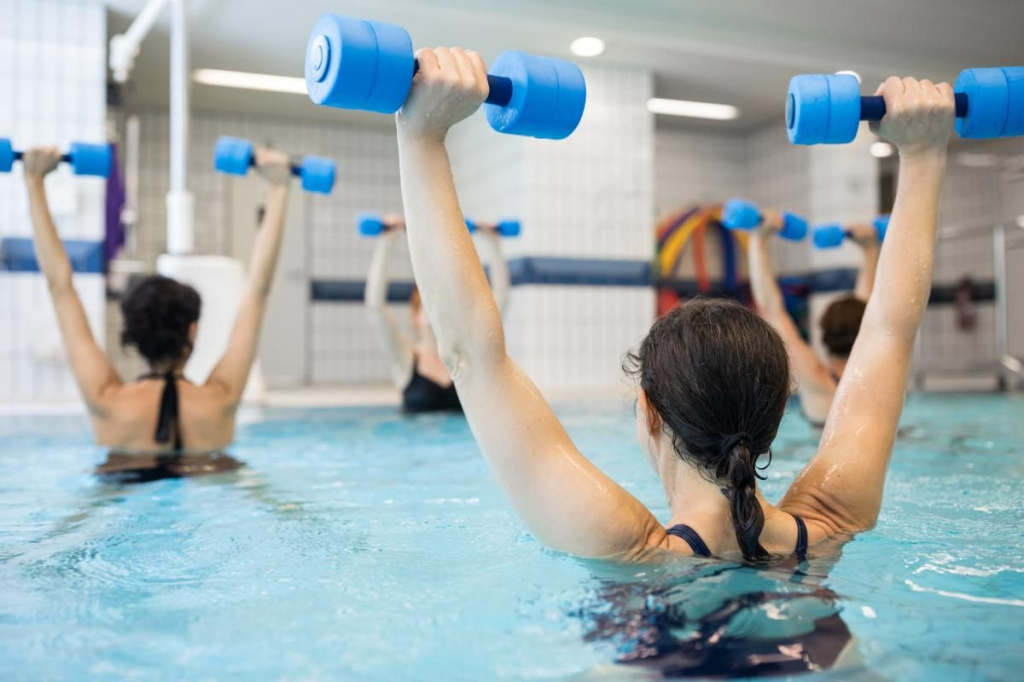
In this context, however, we will specifically use water to not only rehabilitate injuries but also condition the body – resistance training. A common question I get whenever I mention using the pool for hydrotherapy is whether it implies swimming. My response: swimming is a form of hydrotherapy; but hydrotherapy is not (only) swimming. So, no, you do not need to know how to swim to use the pool for a hydrotherapy session, but you could end up learning how to swim in the process. 🙂
Ever heard of aqua-aerobics? It’s really big in Western countries compared to African countries, and you’ll find quite a number of videos of them on YouTube. Basically, it’s aerobics in water. The advantage? It’s softer on the knees, and therefore increases the complexity of moves you can execute. Awesome, right? And no! Aerobics is not just for (elderly) ladies or persons who do not have anything better to do. That’s a common misconception I have come across in my short experience so far. It’s actually quite a workout!
Anyway, back to hydrotherapy. I have held numerous sessions for competitive athletes playing a variety of sports – football, tennis, volleyball, even swimming(!) – and the effects have been astounding, even to me. To quote one of the top football coaches at Kenyatta University, he said that the players seemed to get tired much, much later than they usually would before they began the hydro sessions. This, in turn, helped push the boundaries of their limits…and now they will be playing in an inter-university tournament in China in October, woot woot!
The players even commented during one session that it felt like ‘loading’. A loaded session is one that’s really heavy and packed that usually requires the next training session to be one of (active) rest and recovery.
There are three main reasons I would recommend hydrotherapy to active athletes:
First, recovery. Remember the earlier definition of hydrotherapy being the use of water to feel better? Moving in a pool of cool water has a soothing and recovering effect on the body’s muscles, especially if you have been training in the heat. Besides, when working out, the body generates heat, right? Therefore, being in water speeds up the cooling effect – which is also one of the main effects of sweating!
Second, conditioning. Water is a denser medium than air, meaning that more effort is required to complete body movements. Think of how easy it is to jog on land; now imagine doing the same thing in an area where there is higher resistance. It could be equated to pulling and pushing weights in the gym, but in a much cooler way (hehe). The intensity of conditioning can be modified by training in different water levels. I should probably do an entire article on this, now that you mention it. 🙂
Third, injury rehabilitation (and prevention). Hydrotherapy speeds up recovery due to the – you’ve seen it before, can you guess? – resistance factor in water. Well, there’s that and the body’s buoyancy. Imagine you have a knee injury (especially when it stops you from running as you get younger), hydrotherapy extends your running days by supporting you hence putting less weight on your knees.
I should definitely do an article on this. It’s a fascinating topic, one that I bumped into quite by accident. I hope you do get the gist of it though. 🙂
Hey Coach Maina. My name is Alice and I have been reading your articles. Good job, by the way. I have a question: in a quest to lose weight through exercise, must someone get on a diet? And if so, for how long?
Hey Alice! It’s a blast making your acquaintance, and thanks for the compliments! It’s nice to know that the work is being read. 🙂 Thought I’d add your question to this week’s blog. 🙂
Getting down to your query, I would point out that ‘going on a diet’ may mean different things to different people. Do you mean going vegan? Or perhaps cutting down on the fats? Or perhaps the fast foods? Would you also be referring to eating less, ie starvation? Let’s see if this next paragraph makes sense:
To gain weight, consume more than you burn (athletes tend to do this in the off-season when they are bulking up); to maintain your weight, consume similar calories as those you burn; and to lose weight, consume less than you burn (or rather, burn more than you consume). Does this make sense?
I admit that I am not a nutritionist, and I therefore would be the wrong person to advise you on the intricacies of dieting. Nevertheless, I can still give you the general overview of how this works. 🙂
We consume food to gain energy. The energy in food is broken down to its simplest form – glucose – which is then either used up in the activities of the body or is stored as glycogen in the liver. As we work out and use up the glucose in the blood, the glycogen stores are called upon to supply the needed energy by the body. When the stores are depleted, the next energy source is fat – which would explain why marathoners and cyclists tend to be slim of body.
However, it takes time and training to get the body to readily burn the fat stores. Before this happens, you will be fighting fatigue (think of running for 1 more kilometre after you are super tired), and many times will have stopped your session for a nice meal.
Going back to the blood glucose story, when the glycogen stores are full and there’s glucose in the blood, the excess sugar is then stored as fats. Yes, you read that right: as fats. This explains why you tend to get rounder as you consume lots of sugary foods without necessarily consuming fatty foods like fries, and failing to use up the stored reserves through exercise.
Therefore, to lose weight, you would need to consume less calories than you burn. Please note that this does NOT imply starvation. In fact, starvation would not only make you lose weight, but also make you lose your muscle mass since the body will ‘digest’ the muscles to gain its required dose of energy.
Instead, perhaps eat less sugary foods? Instead of 3 tablespoons of sugar in your tea/coffee, try 1, or perhaps even none at all? Consume the sugar found naturally in foods instead of processed sugar, as another example.
Then, work out longer and/or more intensely. The glycogen stores are limited, and the longer you work out, the more your body adapts to gaining energy from its stored fats. Then, when you eat well after an exercise bout, your glycogen stores will be replenished as required, but not so the fat stores. 🙂
At the end of the day, it’s a win-win: you lose weight and gain your sexiness in the process 😉 compared to starving yourself, which could land you in hospital! And the best part? It soon becomes a lifestyle you can be proud of. 🙂

Hi. My name is Elvis. How important is rest in a workout routine? I’ve been afraid of taking a break because I might reverse the gains I have made. Please advise.
Hey Elvis, nice to hear from you…and you have asked a question that many find they need to ask from time to time. Can you imagine that before I got into the sporting world as a professional, taking a break wasn’t something in my vocabulary back in the day? Interestingly, we had the same fear: everything I have worked so hard to achieve may get erased or reversed.
Truth is, the fear was both well placed and a misconception of sorts. Well placed since the body doesn’t exactly store fitness, and a misconception because rest helps the body make even greater gains in fitness. Do you remember when we spoke about the body’s adaptability to exercise? How you can move from executing a maximum of 10 push-ups to 30 with time and correct progression? Perhaps I can use this example to better answer your question. 🙂
Alright, so you have taken about 2 months to get to a point where you can do 30 push-ups up from 10, and your target is probably 50 or 100 or maybe even 200 – the more the merrier, right? Hehe – and you are feeling really good about your gains. You certainly do not want to press ‘pause’ because you fear you could end up starting from 10 again, and what a bummer that would be!
As much as you do not want to stop, you feel that your body is asking you to give it a bit of a breather. How? Well, even after the stretches, your muscles are taking longer to stop feeling sore; you are getting tired faster than you were during the efforts; you are losing sleep for some strange reason; perhaps even your immunity to diseases seems to be dropping; and you are just unexplainably tired!
Solution? Rest, right? It’s that simple, or at least it should be. But all those fears come back, and you ignore the warning signs and (dashboard) lights.
Possible consequence? Your body will crash on you; short tempers from seemingly out of nowhere; injuries during the push-up efforts; declining health; strained relationships…quitting entirely from exercise as a result.
True, the body doesn’t store fitness, but it doesn’t mean that it all disappears at once! Taking a day’s break in a daily workout routine doesn’t negate the week’s gains, and neither does taking a week-long break after a month or two of exercise. Think about serving a glass of soda or beer: after the initial pouring, you need a few seconds for the foam to settle down before filling the glass, yes?
Well, rest does more or less the same thing here. The level of the actual soda or beer is like a new threshold – say, 25 – up from the 10 you started with (whose threshold was probably 5), and the current max of 30 push-ups is the foam with a threshold of, say, 25. A week’s break would leave you at the threshold, from where you can build on to the next level. Does the analogy make sense?
You could, therefore, argue that rest exposes your new threshold hence pushing up your limits. However, wait too long and you will be back to zero. Suppose the glass had an hour-glass neck that let out 2 drops of soda or beer per minute. If you waited for several days to fill up the glass after waiting for the foam to dissipate, an empty glass is what you would find.
In other words, training for a month and resting for 2 months would leave you in worse shape while training for 2 months and taking a week or 2’s break would set you up for the next level. Do you then see how the balance needs to be struck for rest to be beneficial in the long-run?
Thank you, Elvis, for your question. You have probably helped out hundreds who weren’t sure how to phrase the question out loud. And while on that topic, would you mind checking out ‘overtraining’ in sports? Some of the symptoms and consequences I mentioned earlier may pop up. I would love to know how rest affects your workout routine! 🙂
Now, next week’s article will also feature the question below. What is your opinion on it? You can leave your responses in the comments below or in my email josemariambui@gmail.com. Have a great week ahead!
Cheers!
Hi Coach Maina. I read your article for the first time last week thanks to a friend of mine who recommended it to me. I have heard that exercise can help heal some mental ailments like depression. Is this true?
 WHO'S WORLD OF FANTASY WILL YOU DIVE INTO NEXT?
Leave a comment